Cathedral, coast and culture: A guide to moving to Exeter
Everything you need to know before moving to Exeter from London, Leeds, and beyond
Published on

Written by Ana K.
Contributor
Read more about our contributor
| Typical Distance Covered |
Estimated Completion Time |
Ideal For |
|---|---|---|
50 to 350+ miles |
3 to 72 hours |
Families, professionals, retirees |
Key Takeaways
- People from diverse demographics are moving to Exeter, a fast-growing city with much to offer in terms of lifestyle, jobs, and experiences.
- A smooth relocation to Exeter can be achieved by planning well, strategically coordinating with movers, and organising packing and unpacking.
- Learning about Exeter-specific matters, such as local neighbourhoods, modes of transportation, and fun things to do, can help ease your transition to Exonian living.
Moving to Exeter grants you countless opportunities in terms of career, education, entertainment, and leisure. But before you get to experience all the things that the city can offer, you’ll have to go through the taxing process of relocation.
Fortunately, this highly detailed yet easy-to-read guide is here to help you plan your big move to the historic and hectic city.
Why are people moving to Exeter?
 Riverside scene at Piazza Terracina with paddle sports and promenade views (Source: iStock)
Is Exeter a nice place to live in? Many people are finding that the answer to this question is yes, since Devon’s seat of government has many offerings that suit diverse people with different lifestyles.
Lifestyle and culture
Having a variety of dining and shopping options, art and cultural events, and natural attractions is an excellent reason why a move to Exeter can be appealing. Here, you can also find several institutions—from religious to educational—steeped in history and heritage.
Career and job opportunities
With an employment rate of 79.4% as of 2024—higher than the national average during the same year—Exeter can offer you several career prospects from different fields.
Get your CV ready to look for a job in the city’s most in-demand sectors, including healthcare and nursing, education, logistics, hospitality, engineering, and social work.
Weather and climate
What’s the weather like in Exeter? Many people are attracted to the city’s climate, which comprises balmy summers and mild winters.
The table below shows the state of Exeter weather-wise throughout the year.
| Season |
Average Temperatures |
Description |
|---|---|---|
Winter (December to February) |
2°C to 8°C |
Windy and wet, with occasional snow |
Spring (March to May) |
8°C to 15°C |
Transitioning from rainy to warm |
Summer (June to August) |
11°C to 21°C |
Sunny and warm, with occasional rain |
Autumn (September to November) |
5°C to 19°C |
Transitioning from sunny and warm to rainy and cold |
What should you research before moving to Exeter?
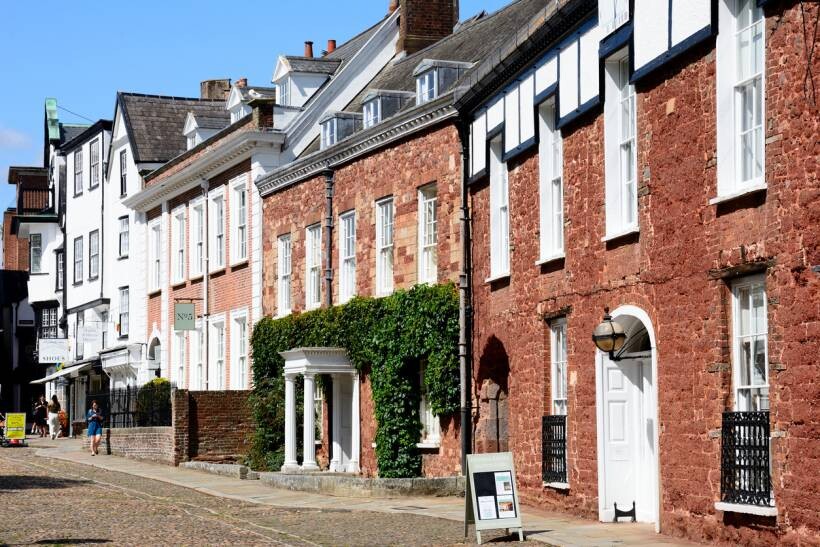 Traditional red sandstone buildings and white Georgian houses along Cathedral Close in Exeter (Source: iStock)
Learn the city’s average cost of living, its best neighbourhoods, and moving-related information so you can settle into your new home smoothly.
Cost of living
The cost of living in Exeter, UK, is around £1,733 for one person per month, which is 6% higher than the national average. A big portion of this amount can be attributed to the following expenses:
| Type of Expense |
Typical Monthly Amount |
|---|---|
Rent |
£762 to £955 |
Utilities |
£292.57 |
Transportation (monthly public transport pass) |
£69 |
Groceries |
£120 to £240 |
Neighbourhood options
Don’t know where to live in Exeter? Discover some of the best places in and out of the city centre for young adults, seasoned professionals, those with families, and retirees.
St Leonard’s
St Leonard’s is a highly coveted location due to its several transportation options, shops and restaurants, outdoor spaces, and beautifully preserved Georgian and Victorian homes. This upscale and lively neighbourhood is close to several schools and offices in the city centre, making it ideal for families and professionals. With its community atmosphere, it is also the perfect area for retirees to reside.
Quayside
If you’re looking for the best place to live when working in Exeter, the Quayside is one location you should have on your radar. Here, there are numerous flats a few minutes from the business district, several pubs and dining spots with waterside views, and various recreational opportunities.
Topsham
Topsham, a peaceful, low-traffic neighbourhood in Exeter near the River Exe, is sought after by people from different demographics (families, professionals, and retirees). This is because the quaint, historic area has charming homes, artisanal stores, and good access to other areas of the city through its own railway station.
Heavitree
Similar to Topsham, Heavitree is favoured by different sections of society due to its plentiful amenities, set amid a pleasant community. In this suburb, you can have quick access to restaurants and stores, transport options, green spaces, and residential properties.
There are also many schools nearby, such as Exeter College, St Peter’s Church of England Aided School, Exeter School, Sidwell’s Church of England Primary School, and Exeter Cathedral School.
Best time to move
When deciding the best time to move, weigh different factors and identify your main consideration. For instance, it may be more important for you to relocate during the off-peak season rather than when prices are at their lowest.
| Season |
Advantages |
Disadvantages |
|---|---|---|
Winter |
Cheapest rates, fewer movers on the road |
Moving and driving and conditions could be better |
Spring |
Weather is starting to warm up |
Demand and rates are starting to increase |
Summer |
Most ideal moving and driving conditions |
Demand and rates are at their highest |
Autumn |
Demand and rates are starting to decrease |
Can be rainy and cold |
Cost of moving
The average cost of relocating to Exeter is £440 to £600, but it can climb to over £2,000 depending on factors like the number of bedrooms, distance covered, size of items, number of movers, and insurance type.
| Moving Scenario |
Estimated Cost |
|---|---|
Moving Scenario |
Estimated Cost |
Plymouth to Exeter |
£440–£700 |
Bristol to Exeter |
£500–£850 |
Cardiff to Exeter |
£600–£950 |
Southampton to Exeter |
£650–£1,050 |
Birmingham to Exeter |
£900–£1,500 |
Manchester to Exeter |
£1,100–£1,800 |
Leeds to Exeter |
£1,200–£1,900 |
£1,400–£2,200 |
What should you do on your Exeter moving day?
 Cluster of red brick houses in Exeter with pitched roofs and chimney stacks (Source: iStock)
Don’t forget to handle every nitty-gritty detail to facilitate a plain-sailing and well-planned move to Exeter.
Strategically coordinate movers and services
When hiring a team that offers house removals to Exeter, make sure to coordinate and confirm all important matters, including rates, insurance coverage, schedules and timelines, and alternative plans in case of unexpected situations.
Your needs (e.g., a large moving van from London to Exeter, specialised equipment to load your things) and the other specifics of your move (e.g., parking or lift access, items that need careful handling) should also be discussed with the movers beforehand.
Carefully transport your belongings
Take the time to learn the proper way to carry loads and pack your belongings (especially if you have fragile stuff to move to Exeter) to prevent damage and breakage during transport. Alternatively, you can hire heavy lifters and packers if you want to go the convenient route.
Critically double-check everything
Create an inventory catalogue and a to-do list so you can easily double-check anything that you might miss. These include your possessions (from pieces of furniture and appliances to clothing and books) and your moving tasks (from cleaning your old flat to making final inspections).
How do you get settled in Exeter after moving?
There are steps you need to take before and after your short- or long-distance move to help you find your footing in Exeter.
Connect your utilities
Ensure you’ll be welcomed by a move-in-ready home by managing your utility connections before relocating:
Gas and electricity: Determine if your house is already connected to gas and electricity through the Find My Supplier and the Power Cut 105 tools. Whether a connection already exists or not, your next step is to contact Wales & West Utilities (for gas) and the National Grid (for electricity) so you can either find out or select your suppliers. You can also change your current suppliers if you prefer a different one. Some of your options are British Gas, E.ON Next, Octopus Energy, and OVO Energy.
Water: Reach out to South West Water to create or update your account.
Rubbish collection: You can call 01392 265010 or visit the Exeter City Council website to learn the rubbish collection schedule in your area or request new bins.
Internet: Directly contact the provider of your choice (e.g., Virgin Media, BT, Sky, TalkTalk) to begin broadband setup at your new residence.
Update your licences and documents
 Close-up of an electoral registration document with a UK driving licence on top (Source: iStock)
It’s crucial to notify government agencies and bodies regarding your change of address and keep the following updated:
Moreover, you should redirect your mail and change your registered Royal Mail address. Also, ensure that your bank, insurance, online shopping, membership, and subscription accounts have your latest residential details.
Secure council-related permits (if any)
If you are planning to do a complex renovation for your new abode, you will likely need approval from your landlord (if renting) and a council permit. The same holds true for major plumbing and electrical system work.
Ensure your family’s welfare
Before settling into your new place, it would be wise to locate and check out all the key amenities and services near you. These include supermarkets and grocery stores, daycare centres and schools, healthcare facilities, parks and playgrounds, and public transportation.
It’s also beneficial to search for establishments like restaurants and cafes, shops and malls, and event venues.
Also think of your pet
If you’re bringing along a furry friend with you to Exeter, make sure that you will have easy access to walking paths and parks, animal hospitals, pet daycare and boarding facilities, supply stores, and pet-friendly establishments.
How do you get around in Exeter?
 Passenger train approaching the platform at Exeter St Davids railway station (Source: iStock)
Familiarise yourself with Exeter’s modes of transportation so you can easily find your way in and around the city.
By train
As the city’s mainline railway station, Exeter St David’s witnesses a significant number of trains travelling to and from various regions across the country every day. This means that if you’re moving to Exeter from London, Cardiff, Manchester, or nearby places like Plymouth or Dawlish, you’ll likely find direct routes to this stop.
Exeter Central, meanwhile, is a major station that is conveniently connected to several stops and transport links in and out of the city centre.
By bus
Exeter’s Stagecoach South West-operated buses ply within the city (including the Exeter Airport) and in nearby towns and suburbs. There are bus stops in both central and peripheral locations, as well as night service in certain areas. Some of the most popular bus routes in Exeter are 4, 4A, 9, 9A, 44, 44A, and C.
By bike
In cycling-friendly Exeter, there are ample amenities and infrastructure for bike riders. Some of these include cycle routes and car-free trails (like those in Exe Estuary and Exeter Canal), parking spaces, and even adult cycle confidence sessions for those who need a little push to start commuting by bike.
By private car
If you’re planning to regularly commute by private car, one question you’ll likely ask a lot is, ‘Why is the traffic so bad in Exeter today?’ As one of the most congested places in the UK, the city has several areas of bottleneck (including Exe Bridges and Heavitree) and crawling traffic during rush hour.
Nevertheless, being behind the wheel has its benefits; it can be more convenient when driving long distances, travelling at night, and carrying heavy items from the grocery store or on the way to Exeter International Airport. It’s also helpful that there are plenty of places to park your car in the city.
By taxi or rideshare
The pros of riding a taxi or rideshare are similar to those of driving your own vehicle. But one added advantage is not needing a place to park. You can find taxi stands across the city, including in South, Sidwell, Bude, Cheeke, North, and Little Queen Streets.
Some hackney carriage firms in Exeter are Apple Taxis and Frankies Taxis, while Uber operates as a ridesharing company.
On foot
Walking can be a viable way to move around Exeter, whether you’re running errands, hankering for an al fresco cup of coffee, or visiting a popular spot. This is because the city does not just have a compact layout; it also has existing and planned infrastructure to make walking a pleasant and safe experience.
By park and ride
One practical form of transportation services in Exeter is the park-and-ride scheme. There are three locations (Honiton Road, Sowton, and Matford) where you can leave your fuel- or electric-powered car and hop on a bus to your destination.
What are fun things to do as a new Exonian?
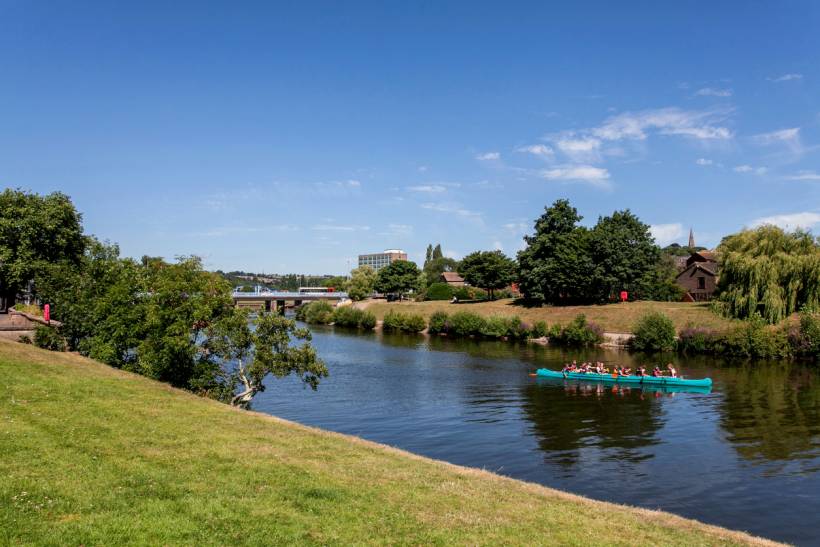 Rowers paddling a long boat on the River Exe with grassy riverbanks and trees in Exeter (Source: iStock)
There are many fun things to do in Exeter, no matter your interests and hobbies, from revelling in the city’s storied past and exploring local markets to dining out and drinking with your newfound friends.
Explore Exeter’s history and heritage
Even before it was established as ‘Isca Dumnoniorum’ by the Romans around 50 AD, Exeter was home to a Celtic tribe during the Iron Age. It also bore witness to Britain’s Anglo-Saxon period, the Norman Conquest, the Tudor and Georgian splendour and squalor, and the havoc and valour of World War II. For these reasons, the city is proud to showcase the many facets of its extensive history, and rightly so.
You can visit the Exeter Cathedral and take in its nine-century-old beauty, tour the Underground Passages, be in awe of the Royal Albert Memorial Museum (RAMM) displays, hit the Roman city wall trail, and stop by the historic Exeter Quayside area.
Enjoy the city’s food and drink scene
Whether you want to dine out or bring home a takeaway meal, you’ll have no trouble locating excellent food establishments in Exeter. Explore cafes, teashops, restaurants, and independent eateries across various neighbourhoods by following the Exeter Food & Drink Trail.
You can also enjoy meals and drinks by the water at the Quayside’s bars, check out the Cathedral Yard’s historic watering holes, or take a leaf out of Charles Dickens’s book and sit for a glass of wine or a bottle of beer at High Street.
Get outdoors along the River Exe and beyond
In the mood for outdoor activities? Various water-based pursuits, such as diving, cruising, fishing, paddleboarding, and boating, await you at the River Exe. From here, you can also visit Riverside Valley Park and other places in Devon that offer a superb backdrop for coastal and countryside cycling and walking, including the Exe Estuary, the Dartmoor National Park, and the South West Coast Path in Exmouth.
Experience Exeter’s arts, culture, and events
The city is teeming with arts- and culture-focused institutions and venues. Apart from RAMM, there’s Tucker’s Hall, the Quay House Visitor Centre, the Exeter Phoenix, the Northcott Theatre, and the Exeter Corn Exchange. The University of Exeter also houses a notable fine art collection and the Bill Douglas Cinema Museum.
Additionally, there are some events in Exeter that you may find interesting, including the Exeter Craft Festival, the Street Arts and Rum Festival, and the Exeter Respect Festival. There are also regular events occurring at the Quay throughout the year.
Explore local neighbourhoods and markets
There are many outdoor markets that regularly take place in the city. These include the farmers’ markets in the Quayside and the West Quarter, Exeter Cathedral’s Independent Market, the Car Boot Sale and Sunday Market at the Matford Centre, and the Exeter Livestock Market in Marsh Barton.
Meanwhile, in neighbourhoods like St Leonard’s, St Thomas, Heavitree, and Topsham, there are several shops, dining places, pubs, and boutiques within walking distance from one another.
Join local clubs, sports, and community groups
Link up with fellow fitness enthusiasts by joining sports and training groups, Zumba and aerobics classes, yoga sessions, and walking clubs. You can also engage in volunteer opportunities and participate in creative and social communities that align with your interests, whether it’s crafting, board games, or reading.
Start your Exeter chapter with Airtasker
 Professional movers lifting furniture into a van as part of a house removals service (Source: iStock)
Ready to start your life in Exeter? Why not hire experts to help you make a safe, swift move to the city? They can help you transport your possessions—from heavy appliances and pieces of furniture to fragile objects and valuables—straight to your new address.
Simply sign up on Airtasker and post a task so you can reach out to taskers and choose the best removals team for the job.
Helpful resources for those moving to Exeter
Here are available resources that you can utilise to make your transition into Exeter life free of confusion and trouble:
Exeter City Council website
The Exeter City Council website has sections on several topics that newcomers may deem useful as they begin settling in the city. These include housing, bins and recycling, council tax payment, transport, and benefits and welfare.
Devon Home Choice
Devon Home Choice, Exeter City Council’s social housing search tool, allows qualified individuals to locate and bid for a rental property in the city and nearby areas.
NHS - Find a GP page
The NHS website’s Find a GP page is a convenient way to search for GPs within your postcode. You can register online through the tool and find the contact details of available GPs near you.
National Careers Service
The National Careers Service has experts who can guide you through your career decisions. You can also find courses and job openings that match your skills and experience through its website.
DevonJobs
The Devon County Council’s DevonJobs is another platform that can help you with your job search in Exeter and the rest of Devon. Aside from listing open positions across various fields, it provides advice to both jobseekers and recruiters.
Learn more about our contributors
Written by Ana K.
Contributor
Ana always puts a premium on accuracy, clarity, and style when writing—a practice that her English degree has instilled in her. She excels at covering topics related to pet care, home and interior design, and food, which count among her varied interests. She also enjoys nature and street photography, as well as travelling. Overall, Ana uses her love for research to engage Airtasker readers with fun, practical content.
FAQs on moving to Exeter from within the UK
Yes. If you’re relocating from Bristol or moving from London to Exeter, you’ll notice that the cost of living in the latter is significantly lower.
Yes, Exeter is costly compared to most towns in Devon. In fact, as of 2024, the most expensive place to rent a home across the entire county is Exeter.
Exeter can be a good place to purchase a residential property rather than rent, as mortgage rates in the city have been declining while its housing market remains robust.
It’s in your best interest to book movers at least four weeks in advance for a short-distance move or about eight weeks before a long-distance relocation to Exeter.
Find removals experts, fast
Find a removals expert
Related price guides

How much does it cost to move house?
Read more

How much does it cost to move house?
Read more

How much do packers cost?
Read more






Related articles

A guide to becoming a removalist
Read more

How to pack mirrors for moving
Read more
How to move gym equipment safely
Read more

How to pack kitchen items for moving
Read more

How to pack books for moving
Read more

How to pack artwork for moving
Read more
How to move a washing machine
Read more

How to move a shed
Read more

How to move a pool table
Read more
How to move a vending machine
Read more

Moving a fridge: How to do it right
Read more

How to move a pinball machine
Read more

How to wrap furniture for moving
Read more

What moving companies won’t move
Read more

Tips for moving house with kids
Read more

Moving Checklist
Read more