- Home/
- Comparisons/
- Electricians/
- LED Light vs. Fluorescent Light
LED light vs. fluorescent light: What are their key differences?
Comparing LED light and fluorescent light based on cost, installation ease, and more
Published on

Written by Milafel D.
Contributor
Read more about our contributor
Key Facts
- LED lighting is a highly energy-efficient, long-lasting, and versatile illumination option that offers instant brightness, excellent color rendering, and significant long-term cost savings despite a higher initial investment.
- Fluorescent lighting is a lighting option with a lower upfront price. However, it has drawbacks, including longer warm-up times, limited dimming capabilities, potential environmental concerns due to mercury content, and a shorter lifespan compared to LED alternatives.
Lighting seems to be one of the most underrated aspects of home building and renovation. However, it significantly influences mood, health, ambiance, and space. For example, warm light creates a cozy atmosphere in a bedroom or library.
Of the many lighting choices available, most get confused between LED light vs. fluorescent light. Which one is cheaper or has higher energy efficiency? Which is more durable or better in the kitchen or garden?
This article compares fluorescent light vs. LED in detail to help you determine which is perfect for your home. You will also learn how to find those who can help you pick and maintain the lighting system to maximize its benefits.
What is LED lighting?
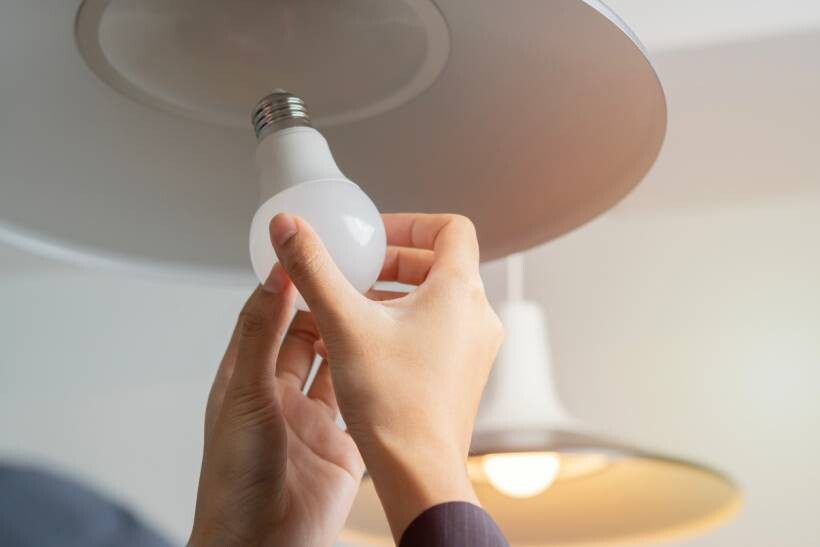 Changing a hanging lamp's LED light bulb at home (Source: iStock)
Also known as a light-emitting diode, LED lighting works through a process called electroluminescence. LED bulbs contain a semiconductor material that allows electrons to move from the n-type to the p-type region.
The electrically charged particles eventually recombine and release energy in the form of photons, which is the light you see. This process significantly differs from that of traditional incandescent bulbs, wherein light heats the filament until it glows.
Contrary to popular belief, LED technology has been around for decades. H. J. Round, an English engineer, discovered it in 1907, and it became commercially available in 1962.
What is fluorescent lighting?
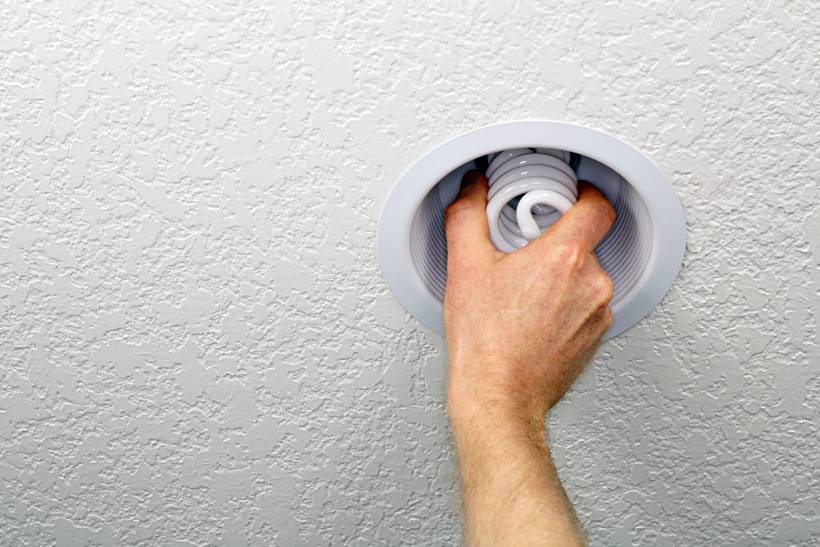 Installing a spiral compact fluorescent light bulb at home (Source: iStock)
As its name suggests, fluorescent lights work through a process called fluorescence. A typical fluorescent tube contains a low-pressure mixture of inert gases, such as neon and argon, and mercury vapour. Outside the tube is a phosphor coating.
When electric current passes through the fluorescent lamp, it flows through the ballast, which regulates the current that excites the mercury vapour until it produces ultraviolet light. Although UV is invisible to the naked eye, it interacts with phosphor, which fluoresces and emits visible light.
Fluorescent light vs. LED light: Which is better for your needs?
Comparing LED lighting and fluorescent lights based on their technology can already tell you how they vastly differ from each other, but which one is better suited for your home needs?
Evaluate them further with these factors:
In terms of cost

When comparing the cost of fluorescent lights vs. LED, consider the purchase price, maintenance, and cost savings throughout the years.
Fluorescent bulbs can be cheaper and easier to buy individually than LED lights. At Walmart, a 4-pack of 60-watt, daylight A19 LED lights can cost almost $8. Meanwhile, you can get a lone 32-watt fluorescent for around $7.
However, an LED is easier to maintain and more long-lasting. Its typical lifespan is 50,000 hours, over three times longer than that of fluorescent tube lights. Its cost per kilolumen has also dropped by 15 times from 2010 to 2019 as the volume of lighting sold increased.
Additionally, the government offers various schemes to reduce purchase, upgrade, or maintenance costs. For example, you can get automatic discounts on LEDs when you buy them from approved distributors.
In terms of installation ease
LED lighting is more straightforward and safer to install than fluorescent lighting for the following reasons:
LED tube lights typically do not require a ballast, so modifying the electrical setup is unnecessary when incorporating them into your home.
Because fluorescent lights contain mercury, it is recommended to have an expert install them.
Universal LEDs can replace fluorescent tubes without downtime. (Note, though, that these kinds are the most expensive and challenging to maintain because they already need ballasts.)
In terms of warm-up time
You can also compare LED vs. fluorescent in terms of their warm-up time or the duration it takes for the light to reach its full brightness.
LED lighting has almost zero warm-up time; it instantaneously illuminates as soon as you turn it on. Its light output also improves as the ambient temperature drops (or the room becomes much colder). The downside is that its components are sensitive to overheating, burning them out prematurely.
Fluorescent lighting can take around five minutes for its brightness to even out. However, it becomes more stable as it heats up, although an overheating fluorescent is dangerous because it can cause fires.
In terms of dimming capability
Many homes use dimmers in their kitchens, living rooms, and even gardens. They can set the mood, minimize light pollution, and provide visual comfort. Dimming lights are also energy-efficient and versatile, as they are easy to combine with other lighting effects.
With LED lighting vs. fluorescent tubes, which works better as dimmers? An LED bulb is dimmable through a built-in driver. (The driver is a separate fixture in panels.) Usually, you can dim it down to very low levels (up to 0.1%) of its maximum brightness.
Its dimming capability is also usually smooth and flicker-free because of pulse-width modulation, which rapidly regulates its brightness, or constant current reduction, which limits the current flow. It can also maintain its temperature color.
Meanwhile, fluorescent lighting has a limited dimmable range of 10% to 20% and requires a separate fixture and compatible dimming control to work. However, it might provide you with more precise control than LEDs, allowing you to create the desired ambience.
In terms of color rendering
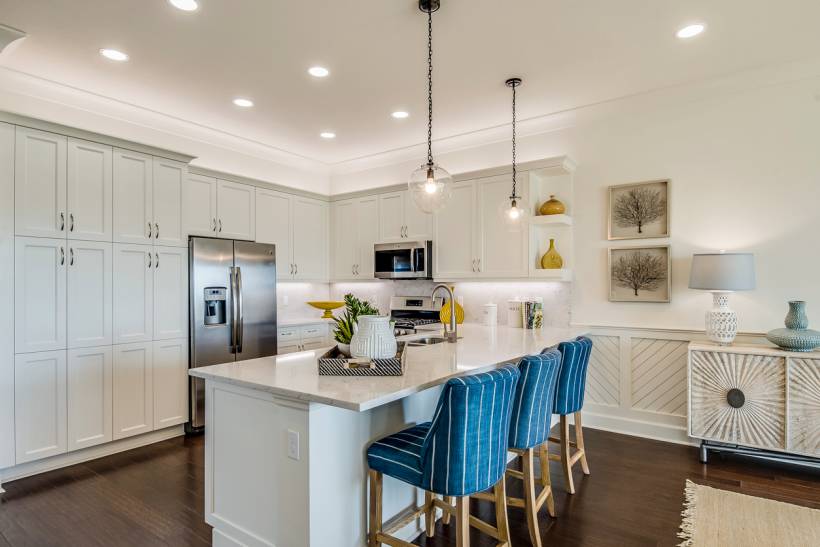 New, spacious kitchen with fancy LED lighting (Source: iStock)
Color rendering is the ability of a light source to accurately depict or reproduce colors, allowing you to perceive objects as they would appear under natural daylight. Color accuracy is crucial in various situations, such as when displaying merchandise in retail stores and exhibiting artwork in galleries.
At home, lights with poor color rendering can make even the most stunning wall paint look washed out or unnatural. A bathroom vanity with proper lighting can make personal grooming and accurate makeup application easy, as the skin tone appears more natural.
The best way to compare how fluorescent lights and LED lighting render shades is through their color rendering index (CRI). An excellent score, which falls between 90 and 100, indicates the most accurate display of colors. A score of 60 to 85 is considered good, which suggests some slight distortion.
Most LEDs are between 80 and 90+ because they produce a more continuous spectrum of light. Fluorescent lighting can be from 50 to 98. Those with a low CRI emit insufficient red light due to their phosphors, so the skin might appear unhealthy or less pink.
In terms of durability
How do you compare LED vs. fluorescent in terms of durability? Of the two, the LED technology seems to be more long-lasting or durable.
Unlike fluorescent lights, they can last up to 50,000 hours or 20 years, whichever comes first. They are also more stable. Because of their solid-state components, they are less likely to break due to shock and vibrations. Additionally, they can handle temperature fluctuations well, although prolonged exposure to heat can cause them to burn out quickly.
Fluorescent bulbs or tubes have a much shorter longevity, at around 7,000 to 15,000 hours. Compact fluorescents are typically useful for only up to 8,000 hours. Further, because they are made of glass and filaments, they are prone to breakage or damage upon physical impact or during strong vibrations.
Fluorescent bulbs are also more susceptible to temperature fluctuations and excessive on-off cycling. They can fail abruptly, compared to LEDs, which gradually lose their light output over time (lumen depreciation).
In terms of eco-friendliness
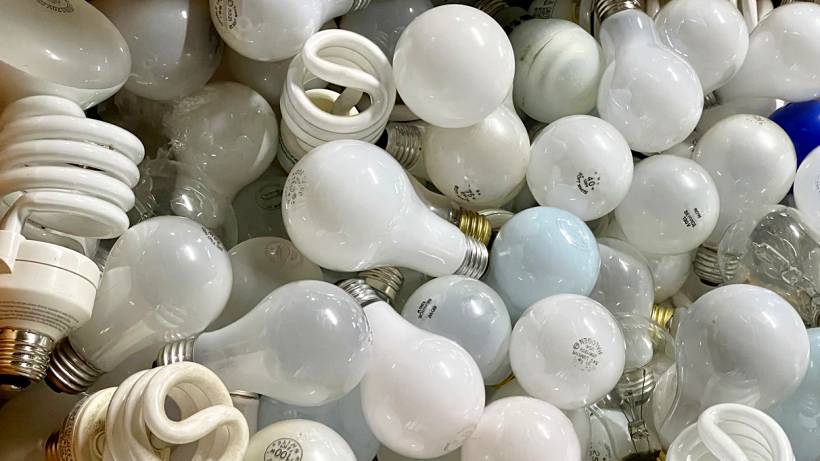 Bunch of old LED and fluorescent light bulbs in a box for disposal or recycling (Source: iStock)
Lastly, you can compare the eco-friendliness of fluorescent light vs. LED energy consumption and recyclability.
LED lighting is hands down the most energy-efficient illumination type. A Michigan study revealed that it is almost 45% more efficient than 4-foot fluorescent tubes. Reduced energy consumption results in a smaller carbon footprint. One explanation is how both utilize electrical energy. LEDs convert up to 95% of their energy into light, while fluorescent bulbs use only 80%.
When it comes to recyclability, LEDs are easier to recycle since they contain fewer parts and no hazardous or toxic materials. Fluorescent lights, on the other hand, use mercury vapour, which requires specialized handling and disposal to avoid environmental contamination or health exposure.
Both, however, are better options than incandescent bulbs, which are currently being banned in favor of more energy-efficient light types.
Request electrician services on Airtasker
After comparing LEDs and fluorescent lamps, you might decide to upgrade your home’s lighting system or need assistance with installation. Airtasker is an excellent platform for finding skilled electricians to assist with your lighting needs.
Here’s how it works:
Post a detailed task. Specify the service you need, such as electrical repair or inspection testing, and indicate whether it’s for LED or fluorescent lighting. Set your budget by determining a fair price based on the job’s complexity and your location.
Review offers. Wait for providers to respond with their quotes. Enquire about their familiarity with LED and fluorescent lighting systems, as well as their approach to energy-efficient installations.
Choose a Tasker. Select the light electrician who best meets your needs.
Whenever you need help in choosing, installing, or maintaining lighting options, go on Airtasker to find a qualified electrician nearby.
Learn more about our contributors
Written by Milafel D.
Contributor
Milafel is an editor and writer with over 15 years of experience. As a contributor to Airtasker content, she brings clarity, creativity, and insight to every piece to help homeowners tackle everyday challenges and turn their living spaces into something truly special. When she’s not writing, Milafel is a devoted cat mama and a teacher’s wife who enjoys belting out tunes at karaoke, journalling her thoughts, and pursuing passion projects.
LED light vs. fluorescent light
| LED Lighting |
Fluorescent Lighting |
|
|---|---|---|
|
Cost |
Higher upfront cost with lower long-term running and replacement costs |
Lower upfront cost with higher ongoing maintenance and replacement costs |
|
Installation Ease |
Simpler installation with fewer electrical components |
More complex installation due to ballasts and hazardous materials |
|
Warm-up Time |
Reaches full brightness instantly |
Requires time to reach full brightness |
|
Dimming Capability |
Supports smooth, wide-range dimming |
Offers limited dimming with specialized controls |
|
Color Rendering |
Provides consistent, accurate color appearance |
Color accuracy varies by type and quality |
|
Durability |
Long lifespan with strong resistance to shock and frequent use |
Shorter lifespan with a higher risk of breakage |
|
Eco-friendliness |
Uses less energy and contains no hazardous materials |
Uses more energy and contains mercury, requiring special disposal |
FAQs on LED light vs. fluorescent light
LED lights are healthier than fluorescent lighting, as they do not emit ultraviolet (UV) radiation and have lower flicker rates, reducing the risk of eye strain and headaches. Additionally, LEDs do not contain mercury, which can be harmful to the organs if inhaled.
Yes, you can use LED lighting in the same fixtures as fluorescent lights. However, you might need to use LED tubes designed to be compatible with fluorescent fixtures or bypass or remove the ballast.
Yes, LED lights attract fewer heat-seeking insects than fluorescent lights. In fact, one study suggests that half of the insects prefer compact fluorescents.
Find electricians, fast
Post a task
Related price guides



Related articles