- Home/
- Comparisons/
- Grocery Delivery/
- Vanilla Essence vs. Extract
Vanilla essence vs. extract: How are they different?
Comparing vanilla essence and extract based on processing level, flavor profile, and more
Published on
Key Facts
- Vanilla essence is an artificial vanilla flavoring whose color typically ranges from amber to dark brown. Its components include chemical flavorings and vanillin.
- Vanilla extract is a flavoring derived from vanilla beans, ethyl alcohol, and water. It has a dark brown color due to how it’s made.
Did you know that most Americans like vanilla as an ice cream flavor? Whether it’s made with vanilla essence or extract, it proved more popular than the likes of chocolate, strawberry, cookies and cream, and caramel.
However, if you would like to incorporate this flavor into your cooking or baking, learning the difference between vanilla extract vs. essence is important. This article, which compares and contrasts the two products, serves as a guide in this regard.
What is vanilla essence?
 Bottle of vanilla essence displayed with vanilla beans and a vanilla flower (Source: iStock)
Vanilla essence is a type of imitation vanilla flavoring composed of synthetic or natural vanillin, ethanol, and artificial flavors. Although typically dark- or amber-colored, some varieties are colorless. In terms of viscosity, vanilla essence is a thin liquid; however, non-alcoholic ones have a slightly thicker consistency.
What is vanilla extract?
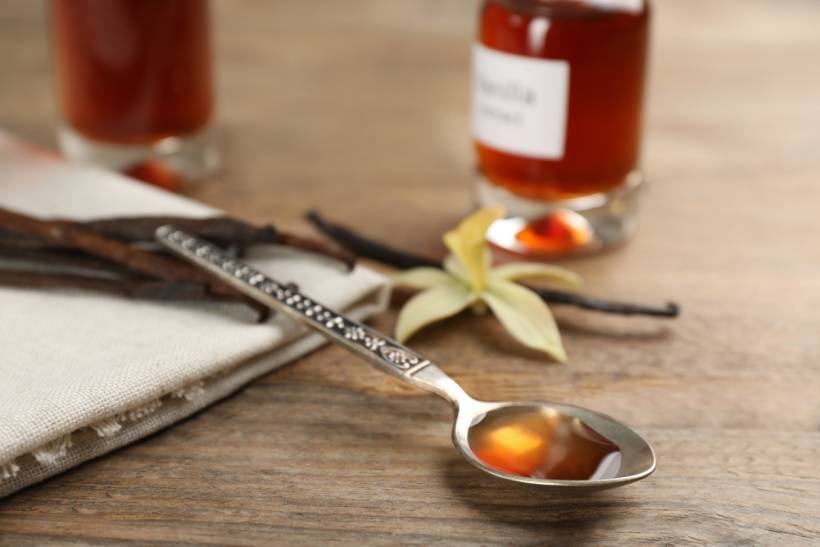 Close-up of vanilla extract in a spoon with vanilla pods and extract bottles in the background (Source: iStock)
Vanilla extract is a natural vanilla flavoring made from vanilla beans, vanillin, and water. Does vanilla extract have alcohol? Yes, ethyl alcohol is also one of its main components. Nevertheless, some companies, like Queen Fine Foods, offer alcohol-free versions.
Vanilla extract has a dark color and sometimes has visible particles from vanilla bean pods. Just like vanilla essence, it has a thin consistency.
Vanilla extract vs. essence: Which is better for your needs?
Learn the difference between vanilla extract and essence in terms of the following factors:
In terms of processing level
 Vanilla beans being sorted and packed into a plastic bag during processing (Source: iStock)
How is vanilla extract made? It is done by grinding and soaking pure vanilla beans in a water–ethyl alcohol mixture to bring out the flavor from vanillin and other natural compounds. This process sounds simple, but completion can take around a year. Afterwards, the mixture will be filtered to remove small particles.
Meanwhile, the vanilla essence ingredients—mainly ethanol, emulsifiers, water, propylene glycol, and artificial coloring and flavorings—are combined chemically. Another core ingredient of vanilla essence is vanillin, whether synthetic or natural. In most instances, synthetic vanillin is derived from either guaiacol or lignin.
In terms of quality assurance
There are no specific rules regarding vanilla essence in the US. Meanwhile, vanilla bean extract vs. vanilla essence regulation in the country is strict. According to the US Food and Drug Administration, a vanilla extract’s ethyl alcohol content must be at least 35%.
In terms of cost
Owing to its natural ingredients and production method, vanilla extract tends to cost more than vanilla essence. In the US, the price of an 8 fl oz jug of vanilla extract starts at around $18. Meanwhile, you can have the same amount of vanilla essence for as low as $1.70.
In terms of flavor profile
 Split vanilla beans showing seeds beside vanilla extract in a small dish (Source: iStock)
Flavor-wise, vanilla extract is more intense and concentrated than vanilla essence. The vanilla flavor one gets from it is also purer, since it is less processed and contains fewer, or no, synthetic ingredients.
Depending on the vanilla bean variety used—Tahitian or Mexican, for example—the aroma of vanilla extract may be described as creamy, woody, or fruity, among other notes. Vanilla essence, meanwhile, is typically described as having a sweet smell.
In terms of health impact
Is vanilla essence the same as vanilla extract in terms of nutritional content? The answer is no. Vanilla extract offers more health benefits; it has a calming effect on both newborns and adults and can somewhat numb the pain of a toothache. It can decrease one’s sugar consumption when used as a sugar alternative.
Moreover, it contains antioxidants like magnesium, calcium, and potassium. Do note, however, that vanilla extract typically has a high alcohol content, and consuming it as a regular alcoholic drink can lead to intoxication.
Meanwhile, vanilla essence has less nutritional value since its components are mostly synthetic. But both vanilla essence and vanilla extract may have ingredients that can trigger allergies.
In terms of versatility
 Scoop of vanilla ice cream served in a waffle cone (Source: iStock)
Both vanilla extract and essence are versatile. You can use them for sweet and savoury food, such as cakes, puddings, pies, and cookies. However, for meals where the vanilla flavor is meant to be the highlight, the extract is preferred. It also lends a rounder flavor to recipes that do not require cooking, such as iced coffee and ice cream.
In terms of shelf life
 Vanilla essence stored in a bottle with vanilla beans on a rustic surface (Source: iStock)
Vanilla extract’s shelf life tends to be longer, lasting for several years. It can even be stored indefinitely if it has a high percentage of alcohol. On the other hand, if you have a bottle of vanilla essence in your pantry, use it within two to four years.
Request grocery delivery services on Airtasker
If you suddenly find yourself wanting to cook a vanilla-laced meal, know that someone at Airtasker can deliver the grocery items you need, including fresh food, right to your door. All you need to do is go to the Airstasker website and post a task with all the relevant details, such as:
Your list of grocery items (including vanilla extract or essence).
Your budget.
Your location.
Wait for Taskers to respond to your post, then choose the one you think is right for the job.
In the mood for a sweet or savoury treat? You can also find someone who can whip up baked goods for you.
Vanilla essence vs. extract
| Vanilla Essence |
Vanilla Extract |
|
|---|---|---|
Processing Level |
Processing is done naturally and can take time |
Processed chemically |
Quality Assurance |
Should abide by particular guidelines |
Not as regulated |
Cost |
Pricier due to ingredients and processing |
Much cheaper |
Flavor Profile |
More intense and purer |
Lacks depth |
Health Impact |
Has more health benefits and a higher alcohol content |
Has fewer health benefits due to its mostly synthetic ingredients |
Versatility |
Perfect for both cooked and uncooked recipes, especially if vanilla is meant to be the flavor highlight |
Apt for dishes where vanilla is not supposed to be the main flavor |
Shelf Life |
Can virtually last indefinitely |
Good for around two to four years |
FAQs on vanilla essence and extract
One teaspoon of vanilla extract is equal to around one and a half to two teaspoons of vanilla essence. Therefore, if you would like to substitute the former for the latter, it is recommended that you increase the amount you’re using.
Growing vanilla plants involves deforestation and the use of fertilizer. Deforestation’s effects include habitat loss and an increased risk of disease. Excess fertilizer use, meanwhile, can lead to soil erosion and water pollution. Both are also contributing factors to climate change.
You can tell if a vanilla extract is pure if its ingredients are vanilla beans, water, and alcohol, and if synthetic vanillin is not one of its components.
Find grocery delivery, fast
Post a task
Related articles